Blown-in insulation over your soffit vents takes minutes to get wrong and costs you every summer
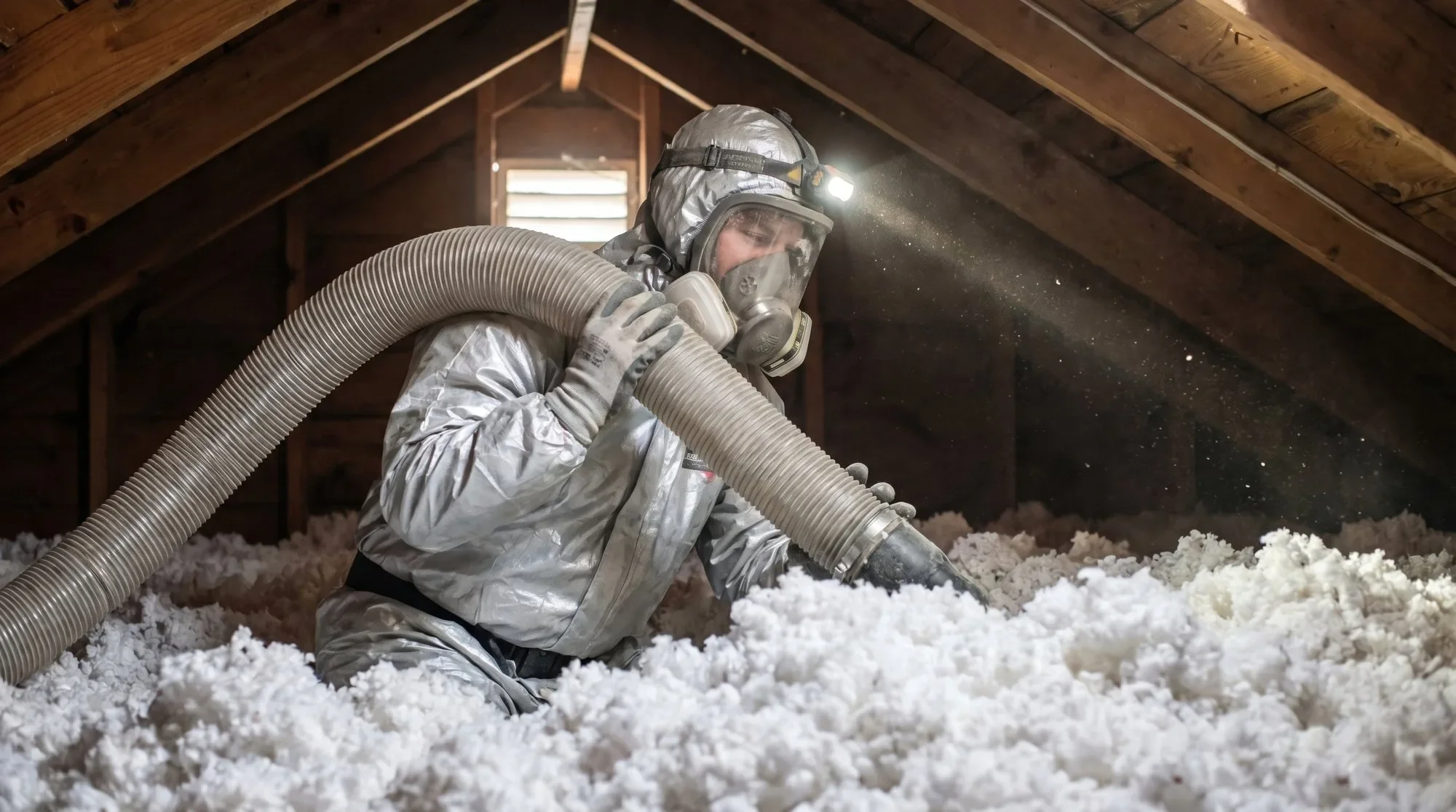
Blown-in insulation is the usual way insulation gets added to an attic that already has some: an installer feeds loose fill through a long hose and spreads it across the attic floor. If your attic has ever been topped up that way, go and look at the edges. Loose fill pushed all the way into the eaves can bury the vents your attic is built to breathe through. Unfortunately, nothing about the outside of the house gives you a hint that it's happened.
An installer can accidentally bury those vents in a few minutes with the hose. After that, you live with it every summer.
How a vented attic is supposed to work
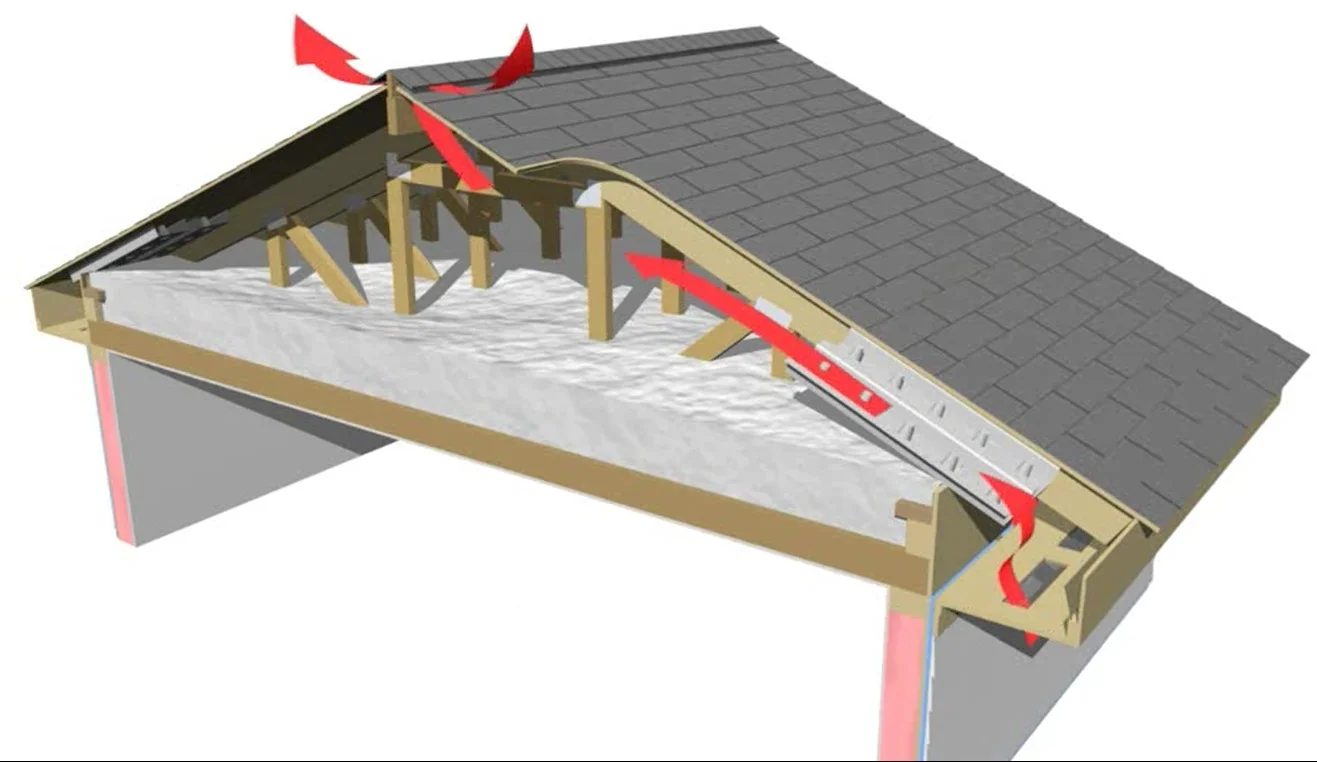
Most attics in Fort Worth houses are vented, which means they're designed to move outside air through the space above your ceiling. Cooler air comes in low, through the vents in the soffits under your eaves. Hot air leaves high, through vents near the ridge or on the roof. That air keeps moving through the attic the whole time. The insulation lies on the attic floor, between that hot moving air and the rooms below, so the heat stays up in the attic instead of soaking down through your ceiling.
The trouble is at the edges. Where the roof slopes down to meet the outside walls, the gap between the top of your ceiling and the underside of the roof shrinks to a few inches. That's exactly where the soffit air comes in.
Loose-fill insulation is blown in from the middle of the attic with a long hose, and whoever is holding it is trying to get an even depth all the way across. So the fill gets pushed toward the walls... and in a space that tight, it can pack straight into the gap and close it. From the ground, your soffit vents still look perfect. They're just opening onto a wall of insulation.
What the code asks for at the eaves
The residential code that Fort Worth and Dallas both adhere to is very direct about this. Insulation isn't allowed to block the airflow at the eaves, and there has to be at least an inch of clear space between the insulation and the roof deck at the vent. Where loose fill is used, the energy code wants a baffle at each soffit vent: a chute that holds the insulation down and keeps an open channel for air above it, as wide as the vent and reaching up past the top of the insulation.
The code's fix keeps the insulation and adds an air path above it.
What a buried intake costs you
When the vents at the eaves are buried, the attic stops pulling in cooler air, and the heat that should be leaving through the roof stays in the attic instead. You pay for that three ways: the rooms under the attic run hotter, your air conditioner works harder to keep up, and if the roof wears out early, the shingle warranty may not cover it.
More heat comes through your ceiling. In a set of test attics at the Florida Solar Energy Center, the setup with far more open soffit area let about 25% less heat down through the ceiling than the setup with ordinary perforated soffits and a low ridge vent. That's a test cell, not your house, and it is not 25% off your cooling bill. It does show that how much air comes in at the bottom changes how much heat reaches the rooms below.
Your air conditioning works harder. In most houses here, the air handler and the ductwork live in the attic. Whatever the attic temperature is, that's the air your cold supply ducts are running through, so the cooled air picks up heat before it ever reaches a room.
The roof warranty may not cover the damage. Five big shingle makers write ventilation into their warranties, but they don't all treat it the same way, so the line some roofers use, "bad ventilation voids your roof warranty," is too simple. GAF keeps its manufacturing-defect coverage in place and excludes damage that inadequate ventilation causes. Owens Corning's warranty also excludes damage from inadequate ventilation. CertainTeed and IKO cut coverage down to 10 years on certain roof assemblies that aren't ventilated the way they specify. TAMKO's warranty excludes shingles installed without adequate ventilation. If a roofer tells you your warranty is void, ask which manufacturer, which version of the warranty, and which clause.
The years a buried intake takes off your shingles are an estimate, not a measurement. A review commissioned by the state of Florida discusses estimates ranging from less than a year to about two years on a 20-year shingle, and says itself that the long-term evidence is limited.
"The most common ventilation fault in DFW"
Some Dallas-Fort Worth roofing companies say this in their marketing, and the ones we found publish no count of attics inspected to back it up. A large Texas field study of new houses, done around Houston, counted other faults instead. It found attic hatches sealed properly in 42% of the observations, and duct systems tight in 19%.
So a buried intake is a real defect worth checking for in your own attic, and none of these sources shows how often it happens here.
Why another roof vent doesn't fix it
The usual pitch, once someone notices a hot attic, is more exhaust: a bigger ridge vent, or a powered fan. Neither one replaces the air coming in at the bottom.
In those same Florida test attics, changing only the ridge vent moved ceiling heat by about 1% to 4%. Opening up the intake moved it by about 25%.
A powered attic fan can do worse than nothing. A fan pulls air out of the attic, and that air has to be replaced from somewhere. When the soffits are blocked, the easiest place to pull it from is your house: through the light fixtures, the attic hatch and every gap in the ceiling. A North Carolina study of eight houses, none of them set up with blocked soffits, still measured attic fans pulling between 104 and 646 cubic feet of air a minute out of the living space, 231 on average. That's air you already paid to cool. In two of the eight houses, the fan created combustion-safety problems, and in one of them the water heater was backdrafting with carbon monoxide measured at 40 parts per million nearby.
So the order matters. Open the intake first, and make sure the ceiling is sealed, before anyone adds exhaust.
What you can check yourself, from the hatch
You don't need to crawl into the eaves to tell whether the vents are buried. You need a flashlight, gloves and a mask, because blown insulation is unpleasant to breathe.
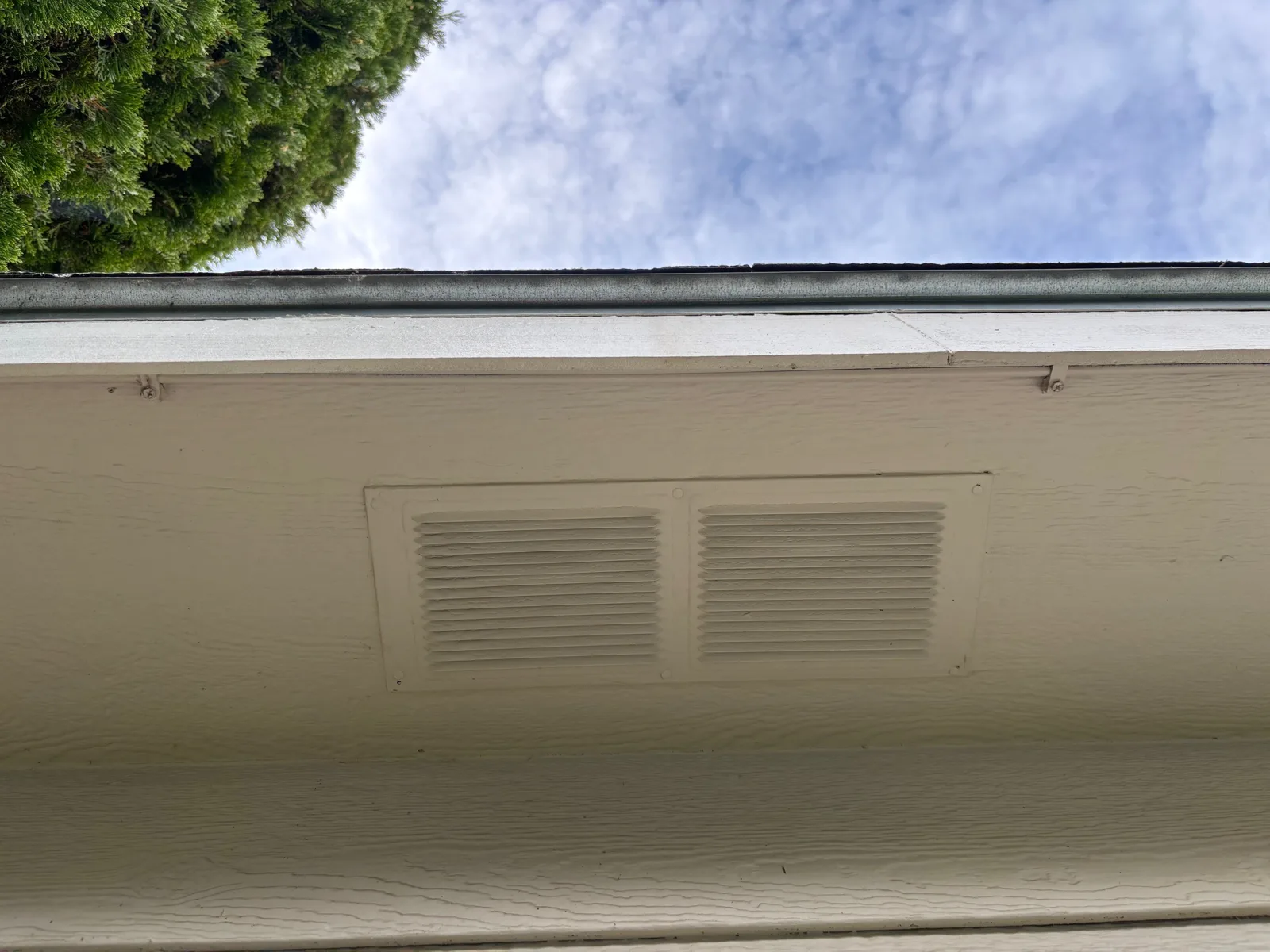
- From the ground, walk around the house and note where the soffit vents are. You're making a map of where air should be coming in.
- From the attic hatch, shine the light toward those eaves. You're looking for baffles, which usually look like cardboard or foam chutes between the rafters, with a clear channel above the insulation.
- Look at where the insulation meets the roof. If the loose fill runs right up into the underside of the roof deck at the edge, with no channel you can see, that's a reason to have it looked at properly. It isn't a reason to start pulling insulation out.
- Look at the ducts and the wood while you're up there. Torn duct insulation, stains on the decking or wet insulation are worth noting too, though moisture can have other causes.
- Stay at the hatch if the attic isn't safe to walk. Step only on the framing, never on the ceiling between it.
Not every attic is supposed to be vented. Some houses are built with the insulation sprayed on the underside of the roof and the attic sealed on purpose. The code allows that, and in that house no air at the soffits is the design. Don't open up a sealed attic because it doesn't match the description above.
And if you're about to have insulation added, ask the installer to show you the baffles at the eaves before they leave. More insulation with the intake still buried leaves the problem in place.
There's more on how clay soil moves a Fort Worth house in why doors and windows start sticking in Fort Worth houses.
Working with Awesome Renovations
A lot of remodeling companies only want the big whole-house jobs and won't take on one attic or one ceiling. I'm Jorge Ventura, and I take both. Awesome Renovations is four people, and I'm one of them, on site rather than dropping a crew off.
Some of what an attic turns up belongs to a licensed trade. The HVAC technician and the electrician on my jobs are licensed; I bring them in and stay on site over the work. The rooms my crew has finished are here.
Tell me what you found in the attic. I'll come and look at it, and I'll tell you what I'd do.
Get Started
Images courtesy of PNNL, from the Building America Solution Center.
For remodeling and repairs in Fort Worth, visit ttscontractors.com/pros/awesome-renovations/
Awesome Renovations 6001 E. Lancaster Ave Fort Worth, TX 76112
