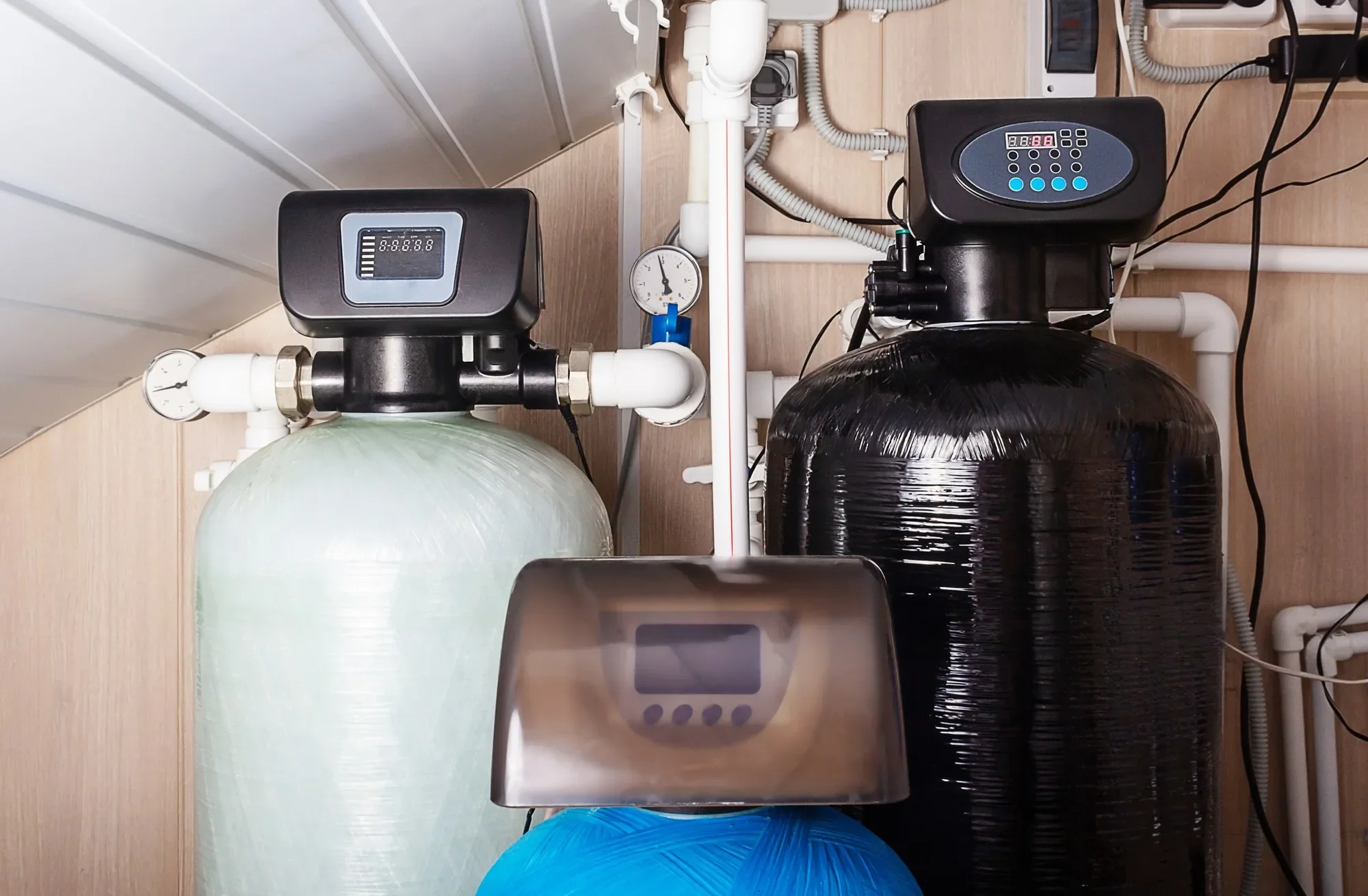
The water softener loop on the outside wall, and why dripping the faucets isn't a plan
Walk around the outside of your house and look where the water comes in. If the main line comes up out of the ground, runs up the brick to a water softener, and goes back down into the wall, that loop is more exposed than almost any other water you own. In a hard freeze, a few feet of pipe on an outside wall is sitting in the wind with nothing but whatever was wrapped around it.
Here's the short version. Dripping a faucet inside can help that loop, but it can't promise to keep it from freezing. And if the loop does freeze solid, it cuts off the water to the whole house. So the protection has to be on the loop itself, before the cold arrives.
How the loop got there
Most houses here sit on a slab, and the main water line runs under it or under the yard. A softener has to go somewhere on that main line, ahead of the faucets it's softening. When one is added after the house is built, the clean way to put it somewhere protected means trenching or cutting into finished walls. The quicker way is to bring the line up the outside of the house, through the softener, and back down.
Most of the year, nobody notices it. In a hard freeze, it's the pipe with the least between it and the weather.
What dripping a faucet actually does
You'll hear that an outside softener loop makes dripping your faucets useless. That's not quite right: a drip inside still pulls water through the loop, but it can't promise to keep it from freezing.
A dripping faucet does two separate jobs:
- It keeps water moving. If the loop is part of your main line, and the faucet you're dripping is inside the house downstream of it, the water feeding that drip has to come through the loop. So the drip does move water through it. Slowly moving water is harder to freeze than still water. It can still freeze, though, and in a long, windy freeze a trickle may not be enough.
- It gives the pressure somewhere to go. A pipe usually doesn't burst where the ice forms. Ice forms a plug, keeps growing, and squeezes the water trapped between the plug and a closed faucet, and the pipe splits wherever that trapped stretch is weakest. An open faucet lets that pressure out. That's from a freezing-pipes guide by the Insurance Institute for Business & Home Safety, posted on the International Code Council's site, and it's why a pipe can freeze while you're dripping and still not burst.
Now the limits. If the loop freezes solid, no water reaches the house at all, and the drip stops along with everything else. The drip also doesn't reach parts of the setup that aren't on that path. Outside faucets are often tapped off the line before the softener, so they never see the drip. The softener's drain line and brine tubing aren't part of the flow to your faucets either. And if the softener is switched to bypass, the tank itself isn't getting any flow.
So keep dripping. Just don't let it be the plan.
What the code and the softener makers say
The plumbing code Fort Worth and Dallas both use says pipes outside a building or in an exterior wall have to be protected from freezing with insulation, heat, or both. Fort Worth's version goes further and names a minimum insulation thickness for pipes in exterior walls. A wrap of foam that's slipped down and left the elbows bare doesn't meet that.
The softener manufacturers are strict about freezing. GE's installation instructions say not to put a water softener anywhere freezing temperatures occur, require the softener, its plumbing and its wiring to be protected when it's installed outside, and put the drain somewhere it won't freeze. Whirlpool's manual says the same about location. Both say freeze damage isn't covered by their warranties.
Whirlpool's manual also clears up a common belief: putting the softener in bypass is not the same as winterizing it. Its procedure for a softener that could freeze lists closing the main, relieving the pressure, moving the bypass, unplugging it and draining it as separate steps. Bypass keeps water flowing to the house, but it doesn't empty the tank or the pipes around it.
How cold, and for how long?
None of the published figures says how long a pipe on an outside wall here takes to freeze.
The figures you'll see come from different situations:
| Where the pipe is | When it can freeze | How long it takes | Where the figure comes from |
|---|---|---|---|
| Uninsulated, in an unheated attic | At 20°F or below | Not given | A University of Illinois field study, reported in the IBHS guide linked above |
| Unused, inside the house | At 20°F | About 4 hours | One insurer's guidance |
| Outside the house | Above 20°F | Not given | The same insurer |
| A softener loop on an outside wall | Not given | Not given | No published figure |
The IBHS guide treats 20°F as an alert point, and warns that more exposed pipe can freeze above it. A loop on a north-facing wall in the wind is more exposed than any other row in that table.
So don't wait for the forecast to hit a number. Get the loop ready while it's still mild.
February 2021 is the reminder of what a long freeze does here. Over nine days that month, Dallas Water Utilities dealt with 324 breaks in city water mains and more than 3,000 requests to shut off water at the meter. But the public records don't say how many of the homes behind those 3,000 shutoff requests had a softener loop. Unknown isn't zero, though.
What to do before this winter
- Find your main shutoff and make sure it turns. Then check where it is relative to the loop. A shutoff on the house side of the exposed pipe can't stop water from the street feeding a break in the loop. Fort Worth Water's winter advice includes knowing where yours is and testing that it works, and its first tip is to insulate all outdoor pipes.
- Look at the loop closely. Insulation should run continuously along both the pipe going up and the pipe coming down, including the elbows and the valves. Look at the drain line too.
- Read your softener's manual for its drain procedure, so you know how to empty it if a hard freeze comes and you lose heat or power.
- Consider heat cable, the thermostatic kind, rated for the type of pipe you have. It only works while the power is on.
- A cover or an enclosure helps, but a box around the softener doesn't promise that what's inside stays above freezing.
- Keep dripping a faucet in a hard freeze, ideally the one farthest from where the water comes in, as a backup.
- Never use an open flame on a frozen pipe.
The permanent fix is to move the loop out of the weather: reroute the line so the softener and its connections sit somewhere protected, or build a properly insulated, heated enclosure around the whole assembly. Moving the line is plumbing work, and in Texas plumbing belongs to a licensed plumber.
Working with Awesome Renovations
I'm Jorge Ventura, a general contractor. I run a four-person crew and I'm on site myself, so the size of the job isn't the limit, and I don't turn down a small one either. When the work is plumbing, the plumber on my jobs is licensed; I bring him in and stay on site over the work. The rooms my crew has finished are here.
Tell me what's on your outside wall. I'll come and look at it, and I'll tell you what I'd do.
Get Started
For home repairs and remodeling in Fort Worth, visit ttscontractors.com/pros/awesome-renovations/
Awesome Renovations 6001 E. Lancaster Ave Fort Worth, TX 76112
